
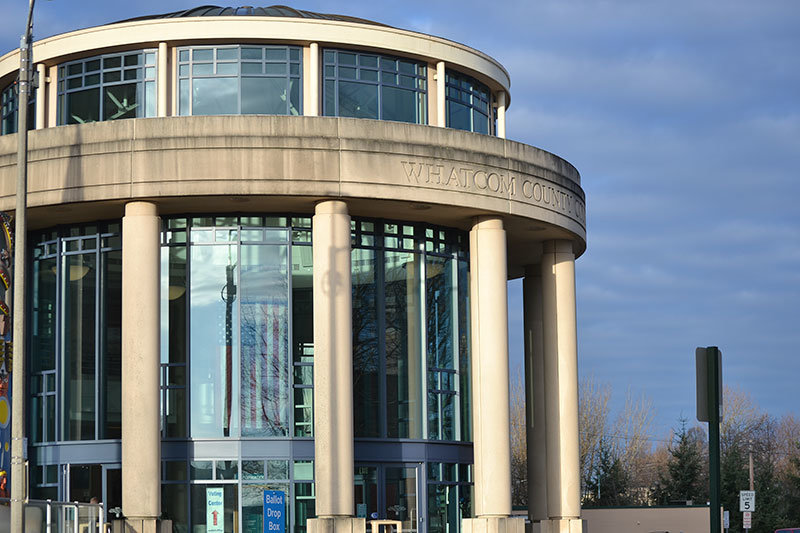
The Whatcom County hearing examiner ruled that the county’s planning and development department did not properly vet 33 approved project permits for the Ferndale Liquid Petroleum Gas Terminal at Cherry Point, according to a March 31 decision.
The projects in question will now be required to undergo more extensive review of their fossil fuel capacity and environmental impact by the county permitting department.
Rajeev Majumdar, the hearing examiner, sided with a coalition of six environmental groups who appealed the permitting process in September of 2025. The coalition argued that AltaGas expanded liquid petroleum gas (LPG) production despite the county amending its code in 2021 to limit the expansion of fossil fuel exports in Cherry Point.
Since those amendments were made, AltaGas made 31 unpermitted changes that it said did not expand its operations, and thus did not need permitting. Another two changes were scheduled to be made, and all 33 were approved by the planning department on September 9, 2025.
The hearing examiner stated that increased marine traffic out of the Cherry Point facility would likely impact southern resident killer whale (SRKW) populations, among other environmental concerns.
“There is sufficient evidence in the record to demonstrate that it is substantively probable that an increase in marine traffic would have an impact on the SRKW without mitigation,” Majumdar wrote.
Jan Hasselman, senior attorney at Earthjustice, one of the six appellants in the hearing, said the decision by the hearing examiner upholds both the law and community expectations.
“The law says counties need to be honest with the community about the risks and impacts of projects like this one,” Hasselman said in an April 1 statement. “This terminal has a shameful history of skirting the law, and it’s about time they were held to account.”
The hearing involved extensive testimony over the definition and calculation of “maximum transshipment capacity,” or the maximum amount of LPG that the facility could process.
According to the hearing examiner report, AltaGas engineers presented the county with a “maximalist” interpretation of how much LPG could flow through the facility, assuming that the facility would be receiving the maximum amount of fuel its pipes could handle uninterrupted, 365 days a year, ignoring logistical barriers such as loading and unloading.
Majumdar called out county officials for accepting that maximalist interpretation from AltaGas engineers.
“This is admittedly not a calculation based in the realities of what occurs,” Majumdar wrote. “It is an error for the Department not to use its judgment and discretion in evaluating what is provided to it.”
Mark Personius, director of Whatcom County Planning and Development Services, testified that he found the AltaGas engineer’s capacity evaluations consistent with county code.
“We don’t know the inner workings of all of those operations and engineering calculations and all of that,” Personius was quoted as saying in the hearing examiner report. “Our code says you accept that engineering analysis and that is what we did.”
The hearing examiner’s decision means the county will have to redo its determination of the AltaGas facility’s capacity and environmental impacts.